How can skilled active managers navigate periods of high market concentration and disruptive forces?
Powerful disruptive forces are creating new challenges in equity markets that could raise hurdles to passive performance in the future. In an era of rapid change, we think charting an active course that’s attuned to mounting risks is the best way to capture long-term US equity return potential.
We’re living through a highly disruptive era. From trade wars to geopolitical tensions and technological innovation, companies across industries are facing huge uncertainties. The artificial intelligence (AI) boom in particular has prompted investor concern over the possibility of a market bubble, alongside the risk of missing out on gains from a revolutionary technology.
These disruptive forces have sharpened the debate about active versus passive investing. Passive portfolios have done particularly well in recent years, as AI-enthusiasm fueled dominant performance of the US mega-cap stocks. Yet even as actively managed equity portfolios have struggled to outperform, passive portfolios could be vulnerable to a reversal in sentiment toward the largest companies.
Identifying Passive Risks in Changing Markets
Portfolios that passively track equity benchmarks can be vulnerable in times of disruption. The S&P 500’s standard cap-weighted index is locked into the prior regime’s winners, which get larger weights as their shares rise. So long as the biggest stocks continue to advance, passively tracking this index will deliver results. However, if the top names are disrupted, a passive investor could be overly exposed to a downturn in stocks with very large weights. What’s more, a cap-weighted benchmark can’t position to capture return potential in future beneficiaries from a range of disruptive trends.
In contrast, the S&P 500 Equal Weight Index is a good proxy for a more diversified view of the US large-cap equity market as it neutralizes distortions created by the mega-caps. However, since it doesn't differentiate between weights apportioned to its members, the equal-weight benchmark is also flawed. Investors who passively track an equal-weight index can’t gain higher exposure to companies poised to thrive in the future.
That’s why we think effective active management is particularly important now. Skilled active portfolio managers can be agile and identify long-term winners and losers of the new regime by positioning equity portfolios to benefit from a potential broadening of the market.
Concentrated Markets: The Risk of Reversal
We know that it’s hard to envision such a broadening after three years of an AI-driven market in which technology titans have dominated market performance. But we’ve already seen the returns of the mega-caps diverge this year. And history suggests that powerful market dynamics—such as the relative resilience of passive performance—don’t last forever.
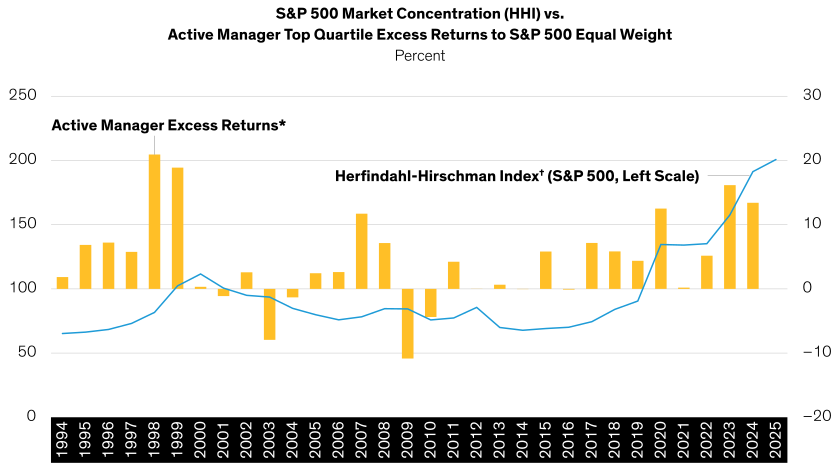
Active portfolios performed well after periods of high market concentration in the past. For example, our research suggests that as markets broadened from 2001–2005 post dot-com concentration, most active US equity portfolios outperformed, according to eVestment data.
Today’s market concentration is extreme. The Herfindahl-Hirschman Index, which measures market concentration, shows that the S&P 500 (cap-weighted) is more concentrated now than at any other time over the past two decades. In fact, the HHI has jumped from 157 in 2023 to 200 today, a 33% increase in concentration over just two years since the launch of ChatGPT ushered in the AI era.